Contents
GLOSSARY
Key terms and definitions
- GEO (Generative Engine Optimization)
- The set of methods that make a brand appear prominently, accurately and positively in the synthesized answers of generative AI engines.
- Conversational search
- Users ask in natural language, follow up and dig deeper with an AI assistant instead of typing keywords and reading each link themselves.
- Frictionless search
- A search experience in which AI is built into every device and operating system, so users no longer decide whether to open an AI tool at all.
- RAG (Retrieval-Augmented Generation)
- The mechanism by which AI retrieves fresh information from a search engine before composing its answer, when training data is not enough.
- Reasoning model
- A model that splits a complex question into sub-questions (query fan-out), researches them and reasons before answering.
- IndexNow
- An open protocol that lets a website notify search engines (such as Bing) the moment its content changes.
- llms.txt
- A proposed web protocol: a Markdown file at the site root that summarizes the site and points AI to its most valuable pages.
- MCP (Model Context Protocol)
- An open protocol that lets AI applications connect securely to a company’s data and services.
- RAPP
- A framework for judging the quality of AI visibility: Regular, Accurate, Prominent and Positive.
- Dark traffic
- Visits that come from AI but are recorded as direct traffic because referral data is missing.
PART 01
Direction and core mindset
How people look things up is at a turning point. ChatGPT, Google Gemini, Perplexity and Microsoft Copilot are moving users away from clicking link after link and into an era of conversational search and frictionless search. The 17 rules in this paper were distilled from months of research and from our experience helping clients measure and improve GEO/LLMO metrics across their content channels.
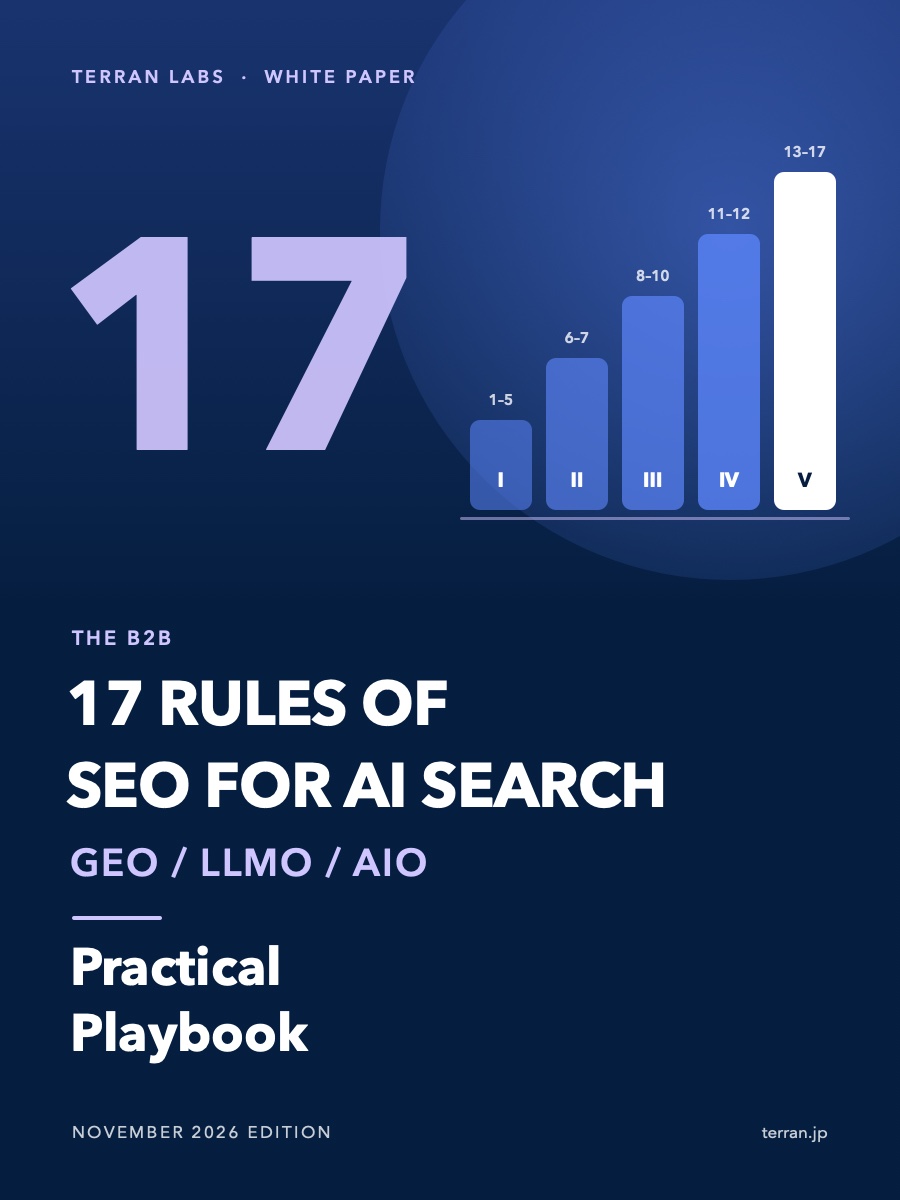
- I. Direction & mindset
- II. Benchmarks & customers
- III. Data & content techniques
- IV. Experiments, partners & agents
- V. Measurement & personalization
The first group explains why to act now: users have changed how they ask, traffic is shifting, Google itself is changing — and AI judges your whole digital footprint, not just your website.
01Focus on conversational search
The core of SEO in the AI era is optimizing for conversational search experiences on large language models.
- Active, lean-in behavior: on ChatGPT, Gemini and Perplexity, users choose the tool, keep asking follow-ups and dig into each topic.
- Passive behavior: AI Overviews appear on the results page without the user ever choosing them.
- A new relationship: AI assistants converse naturally, take in context, brainstorm, push back and generate content on the spot — something keyword search engines never did.
About 50% of messages sent to ChatGPT ask for advice — users treat AI as an advisor that supports decisions. Intent spaces such as practical guidance, solution advice and technical support are exactly where brands need expert content to shape the answer.
02Follow the direction of travel
The most important reason to care about GEO is the user’s direction of travel. ChatGPT reached 1 million users faster than any app in history; in 2025 it logged 63.3 billion visits (24 billion in 2024), averaging about 7 minutes and 4 pages per session.
Compared with Google, AI search accounted for 7.7% of total search traffic in 2025, nearly triple the 2.8% of 2024. The share is still small; the speed is what matters.
03Google is changing too
Google is still a giant at around 83 billion visits a month. In 2025 it drew about 993 billion visits, down 0.5% from 999 billion in 2024 — roughly 6 billion visits. In the same year Gemini drew 9.2 billion visits, more than covering the drop: Google is hedging its bets.
- Gemini now runs in AI Mode, Google Assistant, Android, Pixel phones and many other products.
- Plain blue links — the backbone of classic SEO — appear less often or are pushed further down.
04Prepare for both traditional search and AI search
At the heart of the shift is removing friction. Change is slow — until it’s fast.
People didn’t switch to the iPod because they loved new technology, but because listening to music became frictionless. Tech giants are repeating the “iPod strategy”: Microsoft built Copilot into Windows and added a physical Copilot key; Google made Gemini the default assistant on Pixel, Fitbit, Android and Chrome, and partnered to have Gemini power Siri.
05Expand your whole digital footprint
Users no longer look for prepackaged blocks of information; they ask AI to restructure information into whatever format suits them best — as Google NotebookLM turns a set of documents into a podcast, flashcards or an infographic.
- Your website is your Web HQ, but AI evaluates your entire digital footprint: press, social media, forums, customer reviews, documentation and video.
- All killer, no filler: bloated tag pages, meaningless pagination and keyword-bait content become a liability. A clean semantic structure makes chunking, tokenization and reasoning easier for AI.
- Cover credible touchpoints: quality content on platforms, in the press, on forums and partner channels gives AI more data to cross-check.
PART 02
Benchmarks and customers
AI answers in two different ways: from its training data, or by retrieving fresh information (RAG). Each needs its own strategy, and each shows results at a different speed.
06Optimize for answers based on training data
- Mentions matter more than links: the goal is to be mentioned accurately, often and positively — every mention is a brushstroke in the portrait AI holds of you.
- Visibility follows update cycles: every model has a knowledge cutoff. A new company or product may stay “invisible” until the next training run — keep building solid brand anchors.
- Training sources shape understanding: most models learn from Common Crawl, Wikipedia and long-established sites, so AI may repeat outdated information after you reposition. When AI gets something wrong, search for the exact wrong phrase to trace the source page and update it.
- Use the feedback buttons: thumbs up / down under an answer feed the RLHF process; sending feedback with correct information helps the model adjust over time.
07Optimize for RAG answers
When training data isn’t enough, AI “phones a friend” — it queries a search engine before answering. Showing up in RAG answers depends on whether your content is fresh, trustworthy and easy to index.
| Strategy | How |
|---|---|
| Keep content fresh | Update trend analyses, comparisons, pricing and policies with clear dates. |
| IndexNow | Notify search engines (such as Bing) the moment a page changes, cutting the delay before citation to minutes. |
| Optimize for the engine behind the LLM | ChatGPT and Copilot rely heavily on Bing’s index; Gemini is tied to Google Search. |
| Check core queries | A list of 10–30 questions tied to your brand and revenue, checked regularly on ChatGPT, Gemini, Perplexity and Copilot. |
| Prioritize already-cited pages | Update pages AI already trusts and link from them to your strategic pages. |
| Topic clusters in waves | Publish networks of articles around one topic in waves to signal expertise. |
| Structured data | JSON-LD earns Rich Results — pages with Rich Results are cited by RAG far more often. |
PART 03
Data and content optimization techniques
Once you know where AI’s answers come from, the next step is making your content easy to choose: deep enough for reasoning models, structured enough for AI bots, and consistent across every language and channel.
08Optimize for reasoning models
Reasoning models (DeepSeek R1, Gemini Deep Research, ChatGPT’s thinking mode) and Mixture of Experts architectures don’t just look up keywords: they split a question into subtopics (query fan-out), activate internal “experts” and assemble a reasoned answer.
Content types
- Current events and hot topics
- Opinionated, multi-perspective analysis
- Well-structured, machine-readable pages
Actions
- Publish explainers as soon as your industry changes
- Show your working: data, comparison tables, pros and cons
- Headings that match the sub-questions AI may ask
- Short, quotable sentences up front, entity-rich language
- Be deliberate on social and UGC (Reddit, YouTube, X)
09Optimize holistically for every kind of LLM answer
Every road leads to relevance. AI search optimization is a multidisciplinary sport:
- Phase your optimizations: RAG responds almost immediately, then reasoning models, and training data last. Start testing on RAG for quick measurement before scaling up.
- Think global: LLMs read every language; wrong information in one language version can affect answers in another. Keep multilingual content updated in sync.
- Optimize for AI crawlers: AI bots collect “every track”, not just the hits. Use
robots.txtto steer bots to valuable pages and block tag pages and junk pagination. - Chunk your content: H1, H2, lists, tables and FAQs help AI split and cite accurately.
- Go multimodal: images and video (especially YouTube with timestamps) need clear text descriptions.
- Manage UGC: AI often reads Reddit, Facebook Groups and Quora to gauge community sentiment.
- Handle hallucinations: when AI invents a link about your brand, add a 301 redirect or create a page at that exact URL.
- Be present on AI platforms: build custom GPTs, optimize metadata and check your 16×16 favicon — often the only visual element representing your brand next to a citation.
10Embrace experimentation
The rulebook is rewritten every day. Adopt a fail fast, win big mindset with AI-friendly formats.
- `llms.txt`: a plain Markdown file at
yourdomain.com/llms.txtthat acts as a summary, pointing AI bots straight to your valuable pages without HTML, CSS or JavaScript in the way. - `llms-full.txt`: all your documentation merged into one Markdown file, suited to models with very large context windows.
Plain Markdown can cut 95–96% of tokens compared with HTML — for AI agents running millions of queries a day, that is direct economic value. Six uses: signaling core context, a Markdown sitemap, guiding agent-to-agent (A2A) interaction, reducing hallucinations, providing deep reference context, and saving API costs.
- 1
Isolate a test area
Start with documentation and FAQ pages.
- 2
Keep costs low
Use automatic generation tools.
- 3
Watch the bots
Check AI bot logs for visits to the file.
- 4
Evaluate, then scale
Expand only once you see results.
PART 04
Experiments, partners and the agentic era
AI doesn’t just read content — it partners with publishers and acts on users’ behalf. This group prepares your brand on both fronts.
11Build content partnerships with AI search engines
OpenAI, Perplexity and other AI companies have signed licensing deals with many media groups (Hearst, News Corp, Vox Media, Time, Condé Nast, Der Spiegel and more).
- For large publishers: become an official data partner to keep licensing revenue and citation prominence.
- For commercial brands: shift the focus of digital PR to outlets that have partnered with AI developers — what they publish about you is trusted more by AI.
- Agentic commerce: turn on AI discovery features on commerce platforms (Shopify, Etsy, Wix), structure product data so AI agents can fill a cart, and describe facts over flowery copy.
- Choose your partner ecosystem: favor CMS, payment and CRM providers already deeply integrated with AI (Stripe, PayPal, Wix) so you inherit new integrations without rebuilding.
12Prepare for the age of AI agents
AI agents browse, fill in forms, book appointments and shop on users’ behalf. Your website needs to go from a “brochure” to a destination where tasks get done — otherwise agents will move on to a competitor.
- Awareness
- Consideration
- Decision
- Transaction
- Agent searches
- Agent filters & compares
- Agent recommends
- User confirms
- Feeds & APIs: accurate, real-time product data and “smart endpoints” so agents finish tasks in as few calls as possible.
- Lean Markdown:
llms.txtandllms-full.txtto load accurate data at low token cost. - MCP servers: a “digital USB port” that lets AI applications interact securely with internal data and services.
- AI commerce protocols: AP2, ACP (Agentic Commerce Protocol) and UCP to unlock instant checkout inside chatbots.
- Brand agents & affinity: build your own agent and state clearly which customers you serve, so AI personalization matches the right needs.
PART 05
Measurement, personalization and brand elevation
Business goals stay the same — revenue, profit, leads — but measuring AI visibility takes a new set of metrics, a prompt-tracking process and a deeper approach to personalization.
13Measure with the right metrics
| Traditional SEO | AI search metric | What it tells you |
|---|---|---|
| Total addressable market (TAM) | AI adoption share | How many target customers actually use AI tools |
| Share of voice | Brand mentions | How often you appear in unbranded discovery prompts |
| Indexed pages | Domain citations | Which URLs AI trusts enough to cite |
| Backlinks | Third-party citations | Presence in press and social media that AI ingests |
| Keyword rankings | “Rank” & sentiment | Your mention order and AI’s attitude |
| Organic traffic | AI referrals & conversions | Sessions and orders that start from AI assistants |
R
Regular
- 1.1Do you appear consistently in relevant prompts?
A
Accurate
- 2.1Is product and pricing information correct and current?
P
Prominent
- 3.1Are you near the top of recommendation lists?
P
Positive
- 4.1Does AI’s tone leave a good impression?
Combine server log analysis (bot logs) with an “AI assistant” option in your “How did you hear about us?” form question to capture real conversion data.
14“Rank” in AI answers
- No fixed positions: AI may order by time, alphabetically or by contextual fit — not simply by brand size.
- Sometimes nobody ranks: many generic queries trigger no brand mention at all.
- First place still carries a psychological edge, but sentiment matters just as much: ranking first with negative context is worse than not appearing.
- Bot logs: track OAI-SearchBot, PerplexityBot and ClaudeBot to see which pages are prioritized, catch invented links (404s) to redirect with 301s, and block bots from junk pages.
- Tie it to revenue: AI traffic is still small but high-intent — capture leads from ChatGPT, Perplexity and Gemini through your form question to prove impact to leadership.
15Track prompt performance
Tracking doesn’t need a huge budget — it needs the right prompts, with the ones that skew data removed.
- Qualify your audience first: do your customers use ChatGPT, Gemini, Perplexity or Claude?
- Prepare your brand topics: company name, product lines, abbreviations and regional variants.
- Track entity competitors: brands the Knowledge Graph treats as equivalent (see “People also searched for”), not just business rivals.
- Prune noisy prompts: drop prompts containing your brand or naming a competitor; focus on unbranded comparison and industry questions — that is the real battlefield.
- 1
Source seed questions
From sales and support logs, Reddit, product reviews and “People Also Ask”.
- 2
Expand into prompts
Use AI to create 15–20 natural variants per seed.
- 3
Add to a tracking sheet
Record appearance rate and citation position.
- 4
Execute GEO
Create content for topics where you are absent or ranked low.
- 5
Monitor regularly
Weekly for strategic prompts, monthly for the full set.
16Track traffic from LLMs
Referral data from AI is often fragmented or hidden as direct visits (dark traffic). In GA4’s User Acquisition report, filter sources with this regex:
openai|chatgpt|copilot|gemini|gpt|perplexity|bard|deepseek|claude|meta\.ai- Server-level bot dashboards (such as Wix Studio) separate training crawls from real-time query crawls (OAI-SearchBot, PerplexityBot), with zero-click visibility statistics.
- Dedicated prompt-tracking tools (Limy, Peec AI, Profound, Semrush AI Visibility Toolkit) measure share of AI, cited sources, sentiment and entity maps.
- The phone-book funnel: users get advice from AI, then open a new tab and type your brand into Google. AI did the persuading, but the numbers credit Google — triangulate with bot logs, prompt tracking and your form question.
17Understand customers deeply in the AI era
ChatGPT and Gemini have memory and personalization profiles: AI agents look for the answer that best fits each person (age, build, budget, habits, values). One generic message for everyone no longer works.
- Reviews with user attributes: encourage customers to add height, skin type, intended use and so on, so AI can say “this suits you because people like you rate it highly”.
- Publish audience programs (students, military, healthcare workers, seniors), for example in the footer.
- First-person FAQs: “How do I return an item?” matches the way people ask chatbots.
- Off-site footprint: a positive presence in niche communities (Reddit, Facebook Groups) lets AI link your brand to those attributes.
- State your unique values — organic, eco-friendly, locally made, lifetime warranty — at every touchpoint.
→From 17 rules to a roadmap with Terran Labs
The 17 rules are a map. To make progress, a company needs a steady loop: investigate → fix → measure → improve again. Terran Labs’ AI Search Optimization (GEO / LLMO / AIO) service runs exactly that loop, as a RaaS.
| Rule group | Service module | What we do |
|---|---|---|
| I · II (rules 1–7) | DIAGNOSIS | Design key prompts, survey you and your competitors, analyze cited sources, list inaccurate information; English, Chinese and Korean measurable |
| III (rules 8–10) | TECHNICAL · CONTENT | Crawling and indexing, site structure, structured data; service pages, FAQs, comparison content, case studies |
| IV (rules 11–12) | EXTERNAL | Information in industry media and directories; correction requests; planning press releases and expert articles |
| V (rules 13–17) | MONITORING | Mention rate, share of voice, changes in cited domains, accuracy, before-and-after comparison, monthly report |