1. Introduction: It’s Time to Wake Up to the Rise of Zero-Click Search in B2B Marketing
Imagine a marketing scenario that has become increasingly common among B2B companies today.
Your Marketing team proudly reports that the company website has reached 50,000 monthly visits, with numerous industry-specific keywords ranking among Google’s top three results. Yet when you sit down with the Sales Director, the number of Requests for Proposals (RFPs) and consultation form submissions remains stagnant—or has even declined compared with the same period last year.
What is really happening? Where have your potential customers gone?
The answer lies in a fundamental shift in user behavior: They are still searching for solutions, but they are no longer clicking through to your website.
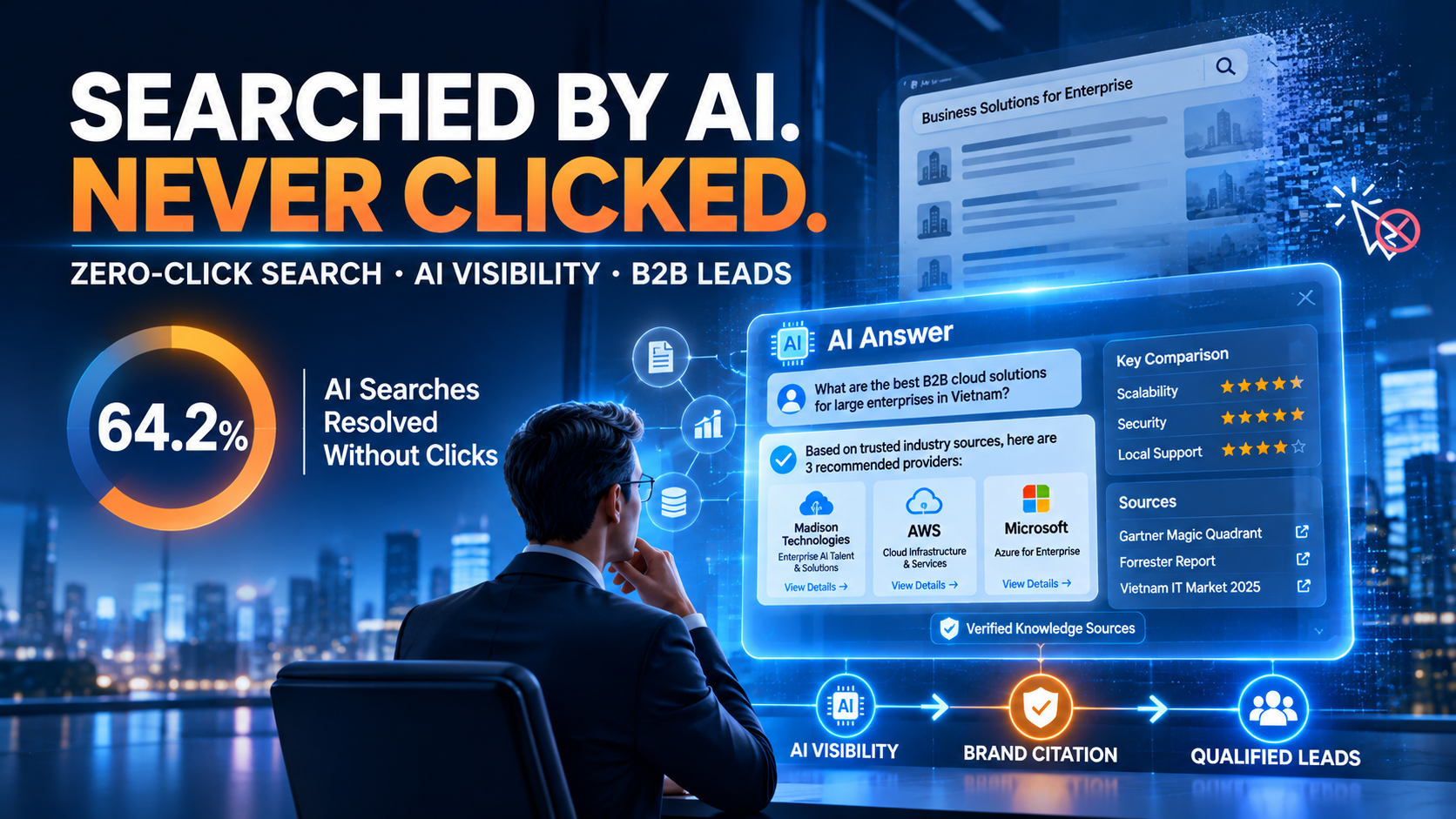
When evaluating technology investments, outsourcing services, or strategic business partners, executives—including CEOs, CTOs, and CMOs—are no longer willing to open ten Google tabs and read thousands of words of promotional content. Instead, they turn to ChatGPT, Gemini, Perplexity, or Claude, enter a complex question, and receive a concise, objective answer synthesized from thousands of data sources within seconds.
This phenomenon is known as Zero-Click Search.
According to the Terran Labs B2B Benchmark Index (Q1 2026 Update), as many as 64.2% of B2B enterprise solution-related searches on AI-powered platforms are resolved directly on the answer screen, without users clicking through to any external website.
If your brand does not appear directly in AI-generated answers, you risk becoming completely invisible to your most valuable customer segments—even if your website ranks No. 1 in traditional Google Search.
This article explores how Zero-Click Search works, uncovers the hidden risks that cause B2B companies to lose sales opportunities, and, most importantly, presents a strategic framework to help your brand become a preferred source for AI-powered search engines to cite and recommend.
2. Understanding Zero-Click Search: Why Are B2B Buyers No Longer Clicking Links?
To understand why clicks are disappearing, we need to examine the shift from two perspectives: B2B buyer psychology and the technical mechanisms behind AI Search engines.
How B2B Search Behavior Is Changing
| Traditional Model (Google Search) | New Model (AI Search) |
|---|---|
| 1. Enter a short keyword or phrase. | 1. Enter a detailed, context-rich prompt. |
| 2. Click through individual search results. | 2. Read a direct, synthesized answer. |
| 3. Read and filter information manually. | 3. Click citation links only when verification is needed. |
| 4. Spend 15–30 minutes comparing options. | Get an initial comparison almost instantly. |
2.1. The New Search Behavior of Executives and Decision-Makers
B2B buyers tend to share three defining characteristics: limited time, high expectations for accuracy, and little patience for lengthy promotional content.
Under the traditional search model, a user might enter the keyword “best B2B CRM software.” Google returns ten links. The user clicks the first result, reads 500 words of introductory content, scrolls down looking for pricing information, finds none, and leaves the page (bounces) to visit the second result. Repeating this process can take anywhere from 15 to 30 minutes.
With AI Search, the same user can enter a detailed, context-rich prompt:
“I am the CMO of a logistics company with 300 employees. Compare the three best B2B CRM platforms currently available that offer automated email outreach and secure cloud integration. Clearly outline their advantages, disadvantages, and estimated operating costs.”
AI Search immediately delivers a multidimensional analysis. The user gets the information they need without clicking a single link. A click only becomes necessary when they want to verify a specific figure or contact a recommended provider directly.
2.2. How RAG Algorithms and AI Search Engines Synthesize Knowledge
AI Search platforms such as ChatGPT Search, Perplexity, and Gemini do not operate as simple repositories of links. They rely on RAG (Retrieval-Augmented Generation) technology to retrieve, process, and generate information.
The process generally involves three stages:
- Retrieval: Search across thousands of web pages to collect information relevant to the user’s question.
- Augmentation and Verification: Cross-reference information from multiple sources to identify and filter out irrelevant, unreliable, or inaccurate content.
- Generation: Use a Large Language Model (LLM) to produce a single, coherent, easy-to-read response.
This ability to retrieve, interpret, and synthesize information on behalf of users eliminates much of the need to click through to articles that offer only generic explanations or introductory information.
3. The Hidden Customer Leakage Crisis: When Your Website Ranks No. 1 in SEO but Remains Invisible in AI Search
Many B2B companies are falling into a state of “dangerous complacency” because their traditional SEO metrics still look healthy. However, beneath those positive-looking numbers lie several potentially serious business risks.
3.1. The Declining Value of Organic Clicks
A website ranking No. 1 on Google for the keyword “B2B Marketing Strategy” may attract thousands of visits every month. But 99% of that traffic could come from students, independent researchers, or mid-level employees looking for reference materials.
Meanwhile, the executives with actual budget authority—the people capable of bringing in business contracts—have shifted to ChatGPT.
Ranking No. 1 in traditional Google Search no longer guarantees that your brand is reaching the right audience: the people with the authority and willingness to pay.
3.2. Losing Control of Your Brand Narrative to Competitors
Imagine a B2B customer asking an AI assistant:
“Should I choose Terran Labs’ marketing automation solution or Company X’s?”
If your brand lacks standardized, reliable data across the AI Search ecosystem, what might happen?
- The AI may retrieve information from random articles, online forums, or even content published by your competitors.
- It may generate inaccurate claims about your pricing, features, or service capabilities—a phenomenon known as AI Hallucination.
- Worse, it may conclude that “Company X offers a superior infrastructure ecosystem” simply because Company X invested in AI Search Optimization (AIO/GEO) before you did.
You could lose a potential customer at the very first touchpoint, without ever having the opportunity to participate in a procurement process or negotiate a deal.
4. Redefining Brand Visibility: From Organic Traffic to AI Share of Voice (AI-SoV)
To adapt to the Zero-Click Search era, B2B marketing leaders must rethink how success is measured. The focus needs to shift from tracking Organic Traffic to managing AI Share of Voice (AI-SoV).
The New Measurement Mindset for 2026
Traditional Metric: Organic Traffic
- Measures the number of clicks leading to your website.
- Can be inflated by irrelevant traffic from visitors with no purchasing intent.
New Metric: AI Share of Voice (AI-SoV)
- Measures how frequently AI mentions your brand or cites it as a source.
- Focuses on your brand’s presence in direct AI-generated answers.
- AI Referral Traffic can deliver conversion rates (CVR) up to 3.2 times higher.
4.1. What Is AI Share of Voice (AI-SoV)?
AI Share of Voice (AI-SoV) is the percentage of relevant AI Search responses—in platforms such as ChatGPT, Gemini, Perplexity, and Claude—in which your brand is mentioned or cited as a trusted source, based on a defined set of industry-related solution queries.
For example: Suppose you evaluate 100 questions that B2B customers commonly ask AI about “Enterprise AI Agent Infrastructure.” If Terran Labs is mentioned or receives a citation link in 75 of those answers, its AI-SoV is 75%.
4.2. A New Framework for Measuring Conversion Performance: AI Referral Traffic and CVR
In the Zero-Click Search era, traffic referred from AI platforms (AI Referral Traffic) may not match the volume generated by traditional SEO. However, the value of each individual click can be significantly higher.
Why? Because when a user clicks a citation link on ChatGPT or Gemini, they have usually already read the AI-generated summary, considered the perspective presented, and decided to explore the source further. They arrive with a much stronger intent to contact the provider or request a consultation (High Buying Intent).
The Terran Labs B2B Benchmark Index 2026 reports that the average conversion rate (CVR) for actual quotation requests from AI Referral Traffic reaches 8.6%, compared with just 2.4% for traditional Organic Traffic.
5. Content Strategies to Help ChatGPT and Gemini Prioritize Your Brand as a Source
How can your website content stand out from thousands of competitors and become a preferred citation source for AI’s RAG algorithms?
Below are three core techniques drawn from the Terran Labs methodology.
5.1. The Conclusion-First Content Model: Answer First, Explain Second
AI Search engines scan and process information at remarkable speed. If your article spends its first three paragraphs discussing historical background or basic definitions, AI may overlook it because its information density is too low.
Instead, adopt the Conclusion-First model:
- In the opening sentence of each article or section: Provide a concise, direct answer to the question.
- In the following paragraphs: Present supporting data, explain the underlying reasons, and develop the proposed solutions in detail.
This structure makes your key insights easier to identify and extract while ensuring readers can quickly understand the main point.
5.2. Standardizing Evidence Tables and Knowledge Cards
AI does not benefit from unnecessarily long, meandering prose. RAG algorithms are better able to extract information from clearly structured data, particularly when it supports comparison and verification.
Package your most important information into formats such as:
- Comparison Matrices: Present data, features, and costs side by side for easy comparison.
- Knowledge Cards / BOX CARD: Organize information into individual cards, each addressing a specific aspect of a product or service.
These structures make critical information easier for AI systems to identify, interpret, and reference in generated answers.
5.3. Developing Exclusive Authoritative Expert Insights
AI Search systems are designed to identify and filter out content that merely copies or repackages other people’s opinions. To become a credible citation source, your content needs to offer original value, including:
- Proprietary Data: Research findings and statistics derived from your company’s own surveys, studies, and real-world business experience.
- Expert Opinions: Clear, well-reasoned perspectives and authoritative insights from your leadership and subject-matter experts.
The goal is not simply to publish more content. It is to publish information that other sources cannot easily replicate.
6. Terran Labs’ Comprehensive Growth Solutions: Turning Zero-Click Search into Sales Opportunities
Terran Labs does more than help B2B companies understand Zero-Click Search. We provide an end-to-end growth infrastructure that enables businesses to establish visibility across AI-powered search platforms while automating the sales conversion process.
The Terran Labs Growth Solutions Ecosystem
1. Terran Labs RaaS
→ Operates AIO campaigns and drives stronger AI-SoV performance.
2. BOX CARD Solutions
→ Packages product knowledge into AI-readable data cards.
3. SALD Platform
→ Automates B2B marketing and sales using data from more than 5 million Japanese companies.
4. Enterprise MCP Integration
→ Connects AI Search with AI Agent infrastructure, including Claude, to support real-time lead processing.
6.1. Terran Labs RaaS (Resource as a Service): Managing and Driving AI-SoV Performance
Rather than requiring your company to independently navigate the complex and constantly evolving algorithms of ChatGPT, Gemini, Perplexity, and Claude, Terran Labs’ RaaS (Resource as a Service) provides a dedicated team of specialists to support your AI Search strategy.
Key activities include:
- Establishing systems to monitor and measure AI Share of Voice (AI-SoV) on a regular basis.
- Implementing multi-layered content strategies using Query Fan-out to increase the likelihood that your brand becomes a preferred answer when B2B buyers search for solutions.
- Optimizing website structures to improve the likelihood of earning citation links within AI-generated responses.
6.2. SALD Platform (Sales Intelligence & Automation): Automating B2B Sales with Data from 5M+ Japanese Companies
Once a visitor clicks through from AI Search to your website, how do you turn that interest into an actual business contract?
SALD is a Sales Intelligence & Automation Platform developed by Terran Labs. It streamlines the entire B2B sales process through an integrated set of capabilities:
- A Database of 5 Million+ Japanese Companies: Identify and filter target businesses based on industry, company size, and location.
- Centralized CRM and Sales Pipeline: Manage contact information and interaction histories through a unified interface.
- Automated Campaigns: Manage Email Outreach sequences and trigger workflow branches based on actual customer behavior, such as email opens, link clicks, and repeat website visits.
- AI Integration via MCP Server: With its built-in MCP Server, SALD allows the AI models your team already uses—such as ChatGPT, Claude, and Gemini—to access and analyze CRM records, campaign data, and customer behavior directly within conversational interfaces. All operations run within a secure infrastructure controlled by your organization.
6.3. BOX CARD: Structuring Enterprise Data for AI Search Algorithms
For AI Search engines to accurately understand and cite your product or service information, that information needs to be clearly structured and accessible.
This is where Terran Labs’ BOX CARD solution comes in.
BOX CARD transforms business cards, company profiles, capability statements, pricing tables, and product features into standardized, structured data cards in an AI-Readable Format.
RAG-based AI Search systems can extract relevant information from these BOX CARD structures and incorporate it directly into responses to user queries within milliseconds.
6.4. Enterprise MCP Integration: Connecting AI Search Touchpoints with AI Agent Infrastructure (Claude)
Terran Labs helps bridge the gap between Discovery and Action through consulting and integration services built around MCP (Model Context Protocol).
When customers discover your business through AI Search and begin interacting with your systems, MCP enables AI Agents—such as Claude AI—to securely retrieve internal data from platforms including Cloud, CRM, and AppSheet.
These AI Agents can then automatically provide consultations, answer in-depth questions, and support sales opportunity conversion around the clock, while adhering to enterprise security requirements.
7. Conclusion and Action Plan: Establishing Your Brand’s Position in the Age of Artificial Intelligence
The AI Search revolution is fundamentally reshaping the rules of B2B marketing. Zero-Click Search is not simply a threat that eliminates marketing opportunities. It is also a natural filter that exposes superficial SEO practices while rewarding brands with genuine knowledge and expertise.
Rather than continuing to spend marketing budgets chasing low-cost clicks through traditional SEO alone, B2B leaders must take a more proactive approach: invest in building AI Share of Voice (AI-SoV) and standardizing their enterprise data infrastructure.
Make sure your brand appears prominently, accurately, and convincingly in the very first answer ChatGPT or Gemini delivers to your potential customers.
The next generation of B2B visibility belongs to brands that AI can understand, trust, and recommend.